The Earliest Embryonic Form of Acupuncture Needles—Bian Stone (Stone Needles)
The prototype of today’s acupuncture needle was the “bian stone.”
Oracle-bone inscriptions from the Yin-Shang dynasty (c. 1600–1046 BCE) depict a figure holding a sharp instrument to treat abdominal pain—strong evidence that stone-based acupuncture (bian therapy) was already in use. From the late Shang through the Western Zhou period (1046–771 BCE), bian stones were the main tools for “needling.” The Sui-dynasty medical scholar Quan Yuanqi explained: “Bian stone is an ancient external therapy. Before mankind could cast iron, stones were sharpened into needles—hence the term zhen-shi (stone-needle).”
Basic Facts
- Chinese term: 针灸针 (Zhēn jiǔ Zhēn)
- Field: Traditional Chinese Medicine (TCM), acupuncture technique
- Synonym in trade: “silver-handled acupuncture needle”
- Core definition: A filiform instrument inserted into specific body points and manipulated by twisting or lifting/thrusting to treat disease; looks like a slender silver pin—hence “acupuncture needle.”
Product Features of Modern Acupuncture Needles
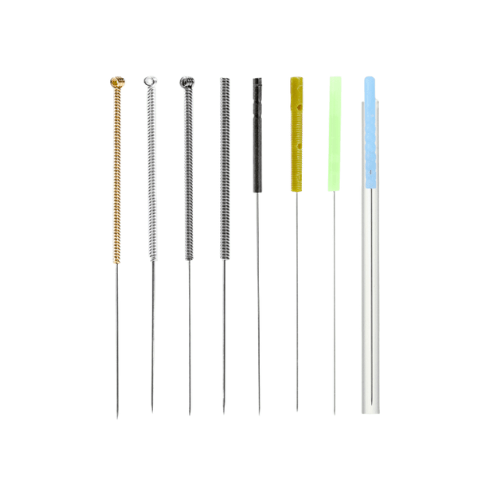
A contemporary acupuncture needle has three parts:
- shaft (smooth)
- tip (sharp but atraumatic)
- handle (threaded or wound to facilitate rotation)
Clinicians seldom use real silver needles today; disposable stainless-steel acupuncture needles dominate because silver is too soft, breaks easily, raises safety issues and costs far more. Gold-colored needles are simply stainless steel plated with titanium-nitride for visibility under teaching lamps.
Innovative packaging: Many needles are supplied pre-loaded in a guide tube. A stamped “ratchet” inside the tube grips the needle handle so it does not fall out, while color codes on the tube instantly show wire gauge (e.g., 0.25 mm = purple, 0.30 mm = blue), helping practitioners avoid规格 mix-ups.
Historical Evolution
- c. 6000 BCE: Kuahuqiao culture (Zhejiang) crafts bone “awls” and “peg-shaped” tools whose blunt or trihedral tips mirror later feng (three-edged) and di (blunt-press) needles—4000 years older than any known bian stone.
- c. 2000 BCE: Neolithic bian stones appear (Inner Mongolia, Shandong).
- 1600–1046 BCE: Yin-Shang oracle bones document bian therapy.
- 475–221 BCE: Huangdi Neijing (Yellow Emperor’s Inner Canon) codifies nine classical needle shapes and the theoretical foundation of acupuncture.
- 113 BCE: Prince Liu Sheng’s tomb (Hebei) yields 4 gold and 5 silver needles—earliest metal specimens.
- Eastern Han (25–220 CE): Hua Tuo and Zhang Zhong-jing refine point selection and contra-indications; Huangdi Mingtang Jing becomes the first dedicated acu-point text.
- Dynasties Tang–Song: Imperial medical schools standardize acupuncture curricula; bronze man models teach point location.
- Today: Global ISO 13485 manufacturers produce sterile, single-use stainless-steel needles in gauges from 0.16 mm (#40) to 0.45 mm (#24) and lengths 15 mm–75 mm.
Nine Classical Needles vs. Modern Variants
Ancient “Nine Needles”
- Chan (sharp arrow)
- Yuan (round)
- Di (blunt-press)
- Feng (three-edged lancet)
- Pi (spear-like)
- Yuan-li (round-sharp)
- Hao (filiform)
- Chang (long)
- Da (large)
21st-century innovations
- Magnetic acupuncture needles
- Electro-acupuncture needles
- Laser-emitting optical-fiber needles
- Nano-coated painless needles
- Drug-coated (pharmacopuncture) tips
- Color-coded disposable acupuncture needles with guide tubes for sterile, one-hand insertion
Clinical Applications & Safety
Indications: Pain syndromes, digestive & respiratory disorders, anxiety/insomnia, neurological deficits, gynecological issues, weight-management programs, addiction withdrawal, etc.
Key safety points
- Always use single-use, sterilized disposable needles.
- Rapid “tube-sp insertion” minimizes patient discomfort and surface contamination.
- Follow clean-field protocol: wash hands, wear gloves, swab skin, dispose in sharps box immediately after use.